
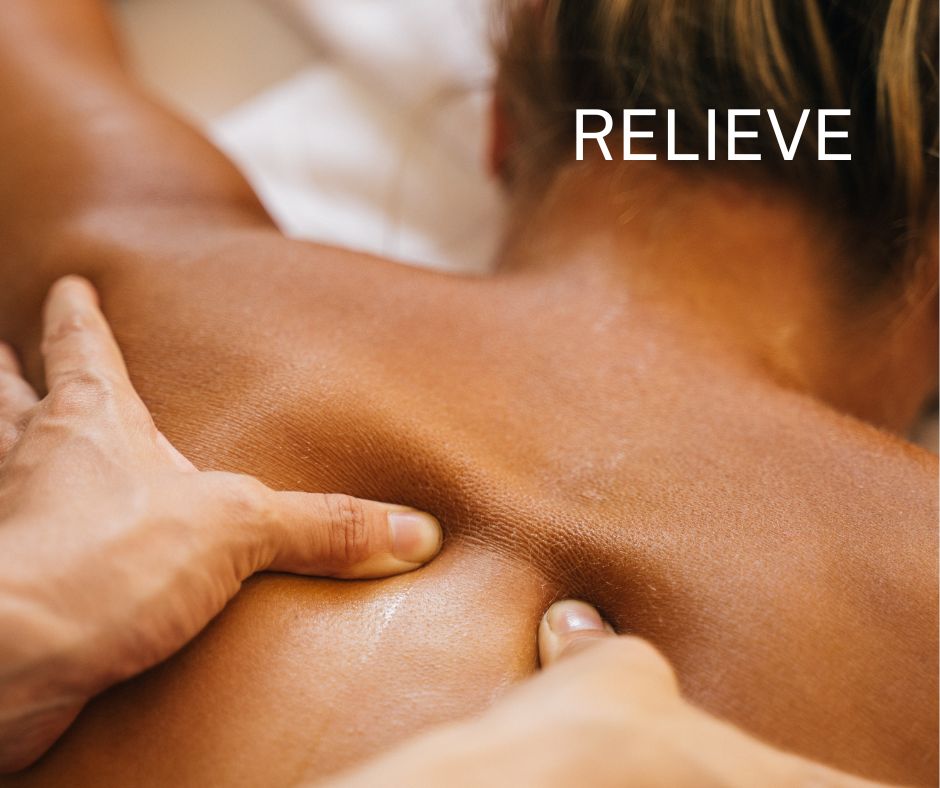
Part II of the Relax, Release, Recover Series
When you’ve been been experiencing muscular pain, perhaps a knot that’s been there for months, an ache in your neck that never quite lets go, or the hip that flares up every time you sit too long, your muscles are looking for release. Release is the second category of how we think about matching you to the right massage, based on what your body needs on any given day.
We use a number of techniques to help release muscle pain and tension. Deep tissue massage is the most familiar one, and also the most misunderstood.
Deep Tissue is not necessarily Deep Pressure
Ask most people what deep tissue massage means, and they’ll say the same thing: hard/deep pressure. Really dig in. Push hard enough that I actually feel something happening. Deep tissue massage should hurt.
However Deep Pressure and Deep Tissue Massage are not necessarily the same thing.
Deep pressure is about intensity, how firm a touch feels against your skin and muscle. It’s a preference. Some people want a lot of pressure because their muscles are so tight that they need that to “feel” the massage. Others are more sensitive and deep pressure hurts. There is nothing wrong with either preference.
However Deep tissue massage is a technique, not a pressure setting. It targets specific layers of muscle and the fascia around it, with a specific focus on an area that needs release: an old injury that never fully resolved, chronic tightness that keeps rebuilding, a postural pattern that’s been years in the making. The goal isn’t to push harder. It’s finding the precise tension and and using the right technique release it.
Some techniques reach deeper tissue without much pressure at all. And muscle that’s solid and bound up can take an elbow and still not be getting real deep tissue work. Our job is finding our way in, so we create ease, not more pain.
A lot of people think a massage has to hurt to work. Here’s how I think about it: on a scale of 1 to 10, where 1 is a light touch and 10 is torture, around a 5 is “that hurts so good.” That’s usually the sweet spot, the most pain you’d want for the massage to still be effective.
If your muscles are already tight and guarded, going in hard and fast backfires. Your body tenses against it, the opposite of what you want. Tell your therapist what you’re feeling. We’ll slow down instead of speeding up, easing the tissue first before applying more direct pressure
The Toolkit
We draw on a lot of techniques to release tension, and your feedback on what feels good matters. Some work across the muscle fibers (cross-fiber friction). Some work with them (muscle stripping). Others stretch or contract the muscle (neuromuscular massage). You might also have heard of some other techniques like myofascial release (slow connective tissue work) and trigger point release (direct pressure on those muscle “knots”). Some sessions bring in acupressure-style work like Shiatsu, using palm and finger pressure to ease tension without digging in. And sometimes we reach for tools instead of hands, like cupping (suction that lifts tissue) or gua sha (IASTM, instrument assisted work along the muscle and fascia that breaks up adhesions).
They’re different tools for different kinds of tension, and we use whatever combination gets you the most comfortable release.
Muscular Release – Our team is on it!
Deep Tissue Release techniques are a natural part of all of our massage therapists’ repertoires, and are part of most treatments. Unless you’ve booked a clear relaxation session, your therapist will likely use release technique if that’s what your body is asking for. It’s a skill everyone on our team draws from, aimed at easing your pain and helping you move better.
But if you are specifically seek deep pressure, let us know, and we’ll match you with a therapist who can meet that preference, too.
If you’ve got a spot that’s been bothering you for weeks or months, whether you’re local to Framingham or coming in from Natick, Sudbury, Ashland, Marlborough, or Hopkinton, tell us about it when you book. We’ll build the session around what’s actually going on, so we can help you feel better!